
A business project needs more than an exciting idea and a large potential market. If you are exploring China BPA or CBPA, practise explaining how a defined audience could become actual buyers, then show how those sales affect costs and profit.
SKT Education's programme overview identifies CBPA as the China Business Professional Alliance and describes case analysis and project-based learning. The exercise below develops a general business skill. It is an original fictional example, not an official CBPA task or a required submission format.
Have a business idea but unsure how to support the numbers? Try the forecast below and identify which assumptions would need evidence.
To discuss participation or a preparation starting point, scan the contact QR code or contact Hanlin on WeChat. Send CBPA FORECAST with your school grade and question.
Start with a defined audience and a time period
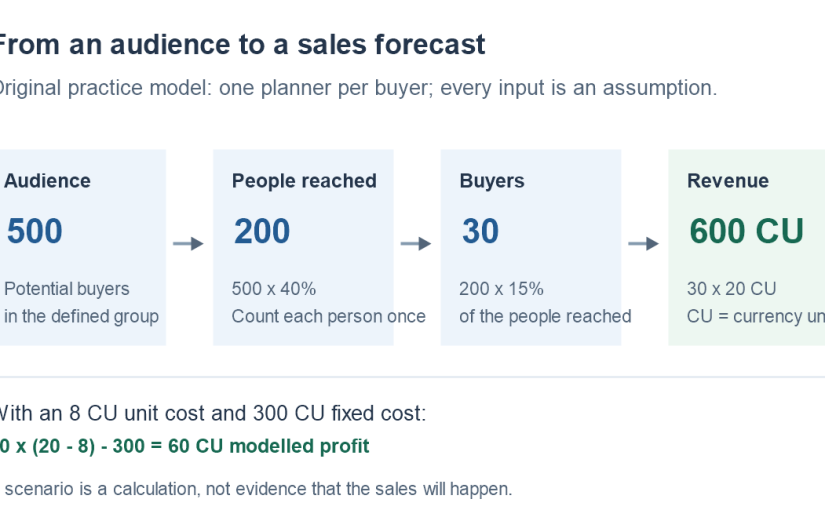
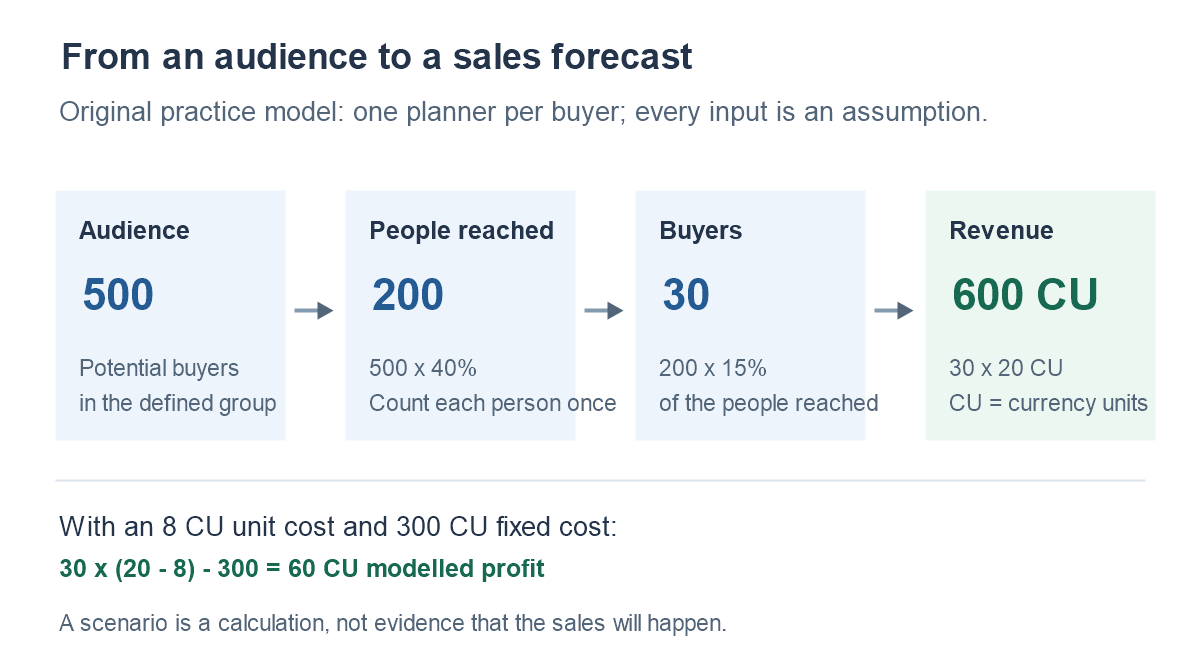
Imagine a student team considering a made-to-order study planner for a single school event. It defines an audience of 500 potential buyers and estimates that its event promotion will reach 40% of them. Of the people reached, it assumes 15% will buy one planner.
The price is 20 currency units (CU) per planner, variable cost is 8 CU per planner sold, and fixed event costs are 300 CU. Assume one planner per buyer, no unsold stock, no capacity limit, and no other costs, discounts or returns. Every input is hypothetical.
Use one event as the forecast period throughout. Mixing annual audience figures with one day's costs would make the calculation difficult to interpret.
Build the calculation in four steps
- Audience: 500 potential buyers in the defined group.
- People reached: 500 × 40% = 200 people.
- Buyers: 200 × 15% = 30 buyers.
- Revenue: 30 × 20 CU = 600 CU.
The 15% purchase rate applies to the 200 people reached, not to all 500 people in the audience. Define the denominator of every percentage before multiplying.
Keep evidence separate from assumptions
The U.S. Small Business Administration's planning guide recommends investigating demand, market size, customer location, alternatives and pricing. Use those questions to examine the inputs rather than choosing percentages that produce an attractive answer.
- Audience size: Who belongs in the group, and what source supports the count?
- Reach: How many unique people could the proposed channel reach during this event? Repeated views by one person are not several different people.
- Purchase rate: What evidence concerns the actual offer and price? General interest in the idea is different from a completed purchase.
- Costs: Are the unit costs and fixed costs documented estimates, or numbers chosen for practice?
A survey can help investigate preferences, but a small convenience sample does not automatically establish a purchase rate for the whole audience. Our customer survey guide explains how to ask clearer questions and report the sample honestly.
Translate sales into modelled profit
In this simplified model, each planner contributes 20 - 8 = 12 CU towards fixed costs and profit. With 30 sales:
Modelled profit = 30 × (20 - 8) - 300 = 60 CU.
Check the same result another way: revenue is 600 CU, variable costs are 30 × 8 = 240 CU, and fixed costs are 300 CU. Therefore 600 - 240 - 300 = 60 CU. The 600 CU sales figure is not the profit.
Compare scenarios instead of hiding uncertainty
Keep the audience, price and costs unchanged, but vary reach and purchase rate. The following are illustrative scenarios, not measured outcomes or probabilities.
| Scenario | Reach | Purchase rate of people reached | Units sold | Revenue (CU) | Profit (CU) |
|---|---|---|---|---|---|
| Lower | 30% | 10% | 15 | 300 | -120 |
| Base | 40% | 15% | 30 | 600 | 60 |
| Higher | 50% | 20% | 50 | 1,000 | 300 |
For example, the lower scenario gives 500 × 30% × 10% = 15 buyers. Its profit is 15 × 12 - 300 = -120 CU. This shows why a positive base-case result alone does not establish that the project will be profitable.
Find the sales level needed to cover the stated costs
The SBA's break-even guide divides fixed costs by the difference between unit selling price and unit variable cost. Here the required quantity is:
300 / (20 - 8) = 25 planners.
If promotion reaches 200 people, selling 25 planners requires a purchase rate of 25 / 200 = 12.5%, assuming one planner per buyer. That is a useful threshold to investigate. The calculation does not prove the audience will reach it.
Try two quick checks
- If only 20 planners are sold at the original price and costs, what is the modelled profit?
- If the price falls to 18 CU and sales remain at 30 planners, what is the modelled profit? Keep every other assumption unchanged.
Show the answers and reasoning
Question 1: 20 × (20 - 8) - 300 = -60 CU. Revenue is 400 CU, while total costs are 160 + 300 = 460 CU.
Question 2: 30 × (18 - 8) - 300 = 0 CU. Lowering the price removes 2 CU of contribution on each of 30 sales. Do not assume a price reduction increases demand unless you model and support that separate change.
Make your next project discussion easier to follow
Show the audience definition, forecast period, calculation and supporting evidence together. Label assumptions clearly and preserve the source behind any observed figure. A teammate should be able to reproduce the result and explain which input would change the conclusion.
For programme selection and broader study, read our China BPA and CBPA preparation guide. Confirm current eligibility, division, theme, deadlines and permitted support in your organiser's instructions. This practice model teaches a method that you can examine independently; your actual project should reflect your own research and reasoning.
Discuss your CBPA next steps with Hanlin
Exploring China BPA or CBPA, comparing study paths or planning your first business project? Scan the QR code and send CBPA FORECAST. Tell us your starting point and the question you want to work on.

On your phone, use the button above. You can also save the QR image and scan it within WeChat.
Include these details in your message:
CBPA FORECAST
School grade and curriculum:
Previous business study or activity experience:
Preferred format: individual study, team project or undecided.
Team status, if relevant:
Main question: participation, study path or preparation.
Sources: SKT Education's programme overview and the SBA's market-research and break-even guidance linked above. The example, diagram, scenarios and exercises were created for this article.