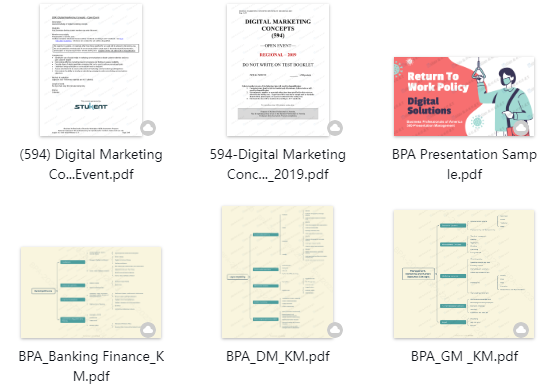

In the landscape of international high school business competitions, while the Wharton Investment Competition is the "pinnacle" of financial investment, BPA (Business Professionals of America) serves as the "melting pot" for hands-on experience across all business fields. As a business competition officially endorsed by the National Association of Secondary School Principals (NASSP), BPA attracts tens of thousands of students worldwide who aspire to a career in business. Given BPA's wide variety of sub-categories, many students hesitate, wondering: Is BPA right for me? How difficult is it to win an award? This article will comprehensively break down the core logic of BPA for you.

I. Who is the BPA Business Competition for?
BPA's biggest characteristic is that it is "extremely diverse in its subjects". It doesn't solely test finance or accounting, but spans four major areas: financial accounting, business management, information technology, and marketing. The following three types of students align best with BPA:
1. "All-rounder" Students Wanting to Explore the "Big Business" Direction
Target Audience: If you currently only know that you want to study business but are unsure whether to choose accounting, marketing, or management, BPA is the best "touchstone". Students can choose from various formats including objective assessments, business presentations, and team documentation based on their interests. This flexibility is great for those wanting to clarify their academic direction through competition.[reference:0]
2. Strong Communicators and "Stage-Presence" Presenters
Target Audience: Unlike purely paper-based tests, BPA includes extensive live presentation sessions. This suits students who are outgoing, skilled at creating high-quality slides, and adept at presenting business plans in fluent English. BPA judges place great value on professional demeanor, including business attire, eye contact, and the ability to think on your feet.[reference:1]
3. International Students Aiming for Top 30 Universities
Target Audience: Admissions officers highly value a student's "career readiness" when considering a business background. BPA, known as a "preparatory course for the workplace," provides awards that strongly prove you not only possess academic knowledge but also the practical ability to solve real-world business problems. It serves as a powerful endorsement for applications to business schools in the U.S. and U.K.[reference:2]
II. How Difficult is the BPA Business Competition Preparation? (Breaking Down the Three Challenges)
Winning awards in BPA presents a characteristic of a "moderate barrier to entry, but extremely difficult to reach the top". The specific difficulties are reflected in the following dimensions:
1. The "Professionalism" Challenge in Knowledge Coverage
The Challenge: The objective section of BPA examines professional knowledge in great detail. Many test points involve commercial law, tax rules, advanced accounting standards, etc., which are only superficially covered in standard AP/IB/A-Level textbooks. Students need to dedicate their summer to significant extracurricular academic strengthening.[reference:3]
2. The "Mental Toughness" Test of Live Presentations
The Challenge: The final round of BPA usually includes a judge's Q&A session. The judges, often real-world industry professionals or professors, will pose extremely sharp questions about your plan. If the team's coordination isn't tight or if they lack a deep understanding of their plan, it's easy to crumble psychologically under the spotlight.[reference:4]
III. Strategic Advice & Key Reminders (Supplemental)
Based on additional BPA resources, several strategic points and common pitfalls were identified:
Award-winning Probability: The BPA China preliminary round has an award rate of about 60%, and the global finals advancement rate exceeds 25%[reference:5].
Group Formation Advice:
Avoid Homogeneity: Complement skills across team members (e.g., strategic analyst, content strategist, visual designer, lead presenter).[reference:6]
Avoid Full Same-Grade Teams: Cross-grade teams can complement knowledge (e.g., upperclassmen mentoring underclassmen in data analysis).[reference:7]
New Rules for 2025-2026 Season:
ML Category Supports Chinese: Students in grades 6-9 can submit business plans in Chinese, lowering the language barrier.
S-Classic Category Theme Freedom: Participants can bring their own projects; no longer limited to fixed themes. Choose from directions like "Business × Tech" or "Business × Social Good".
Application Value: BPA awards can be included in Common App's "Honors" section, and the months-long preparation process naturally qualifies as a "deep extracurricular activity" for the Activities list.[reference:10]